Trying to decide between CNC machining vs traditional milling for your component? This plain-language guide covers precision, speed, cost, and repeatability, so you can choose the right process with confidence.
When you need a metal component made, one of the first decisions a fabricator faces is which machining process to use.
Two of the most common options are CNC machining and traditional milling. Both remove material to create a finished part. However, they do it in very different ways, and the right choice depends entirely on your component, your volume, and your quality requirements.
This guide explains both processes in plain language. By the end, you will know exactly which one suits your project and why.
What Is Traditional Milling?
Traditional milling, also called conventional milling, uses a rotating cutter to remove material from a stationary workpiece. A skilled operator controls the machine manually, adjusting feed rates, depth of cut, and tool position by hand.
Traditional milling excels in low-volume production, prototyping, and when unique one-off parts are required. It offers flexibility in setup and can be cost-effective for simple geometries without stringent tolerance requirements.
The process relies heavily on the operator’s expertise. An experienced machinist can produce good results on straightforward parts. However, the quality of the finished component depends significantly on the skill and attention of the person at the machine.
Where Traditional Milling Works Well
Traditional milling suits specific situations. It works well for very simple shapes with generous tolerances, low-volume jobs where setup cost outweighs automation savings, and situations where a quick manual modification is needed on an existing part.
Additionally, traditional milling can offer faster setup on extremely simple, one-off jobs. There is no programming time, no CAM preparation, and no machine calibration cycle before cutting starts.
What Is CNC Machining?
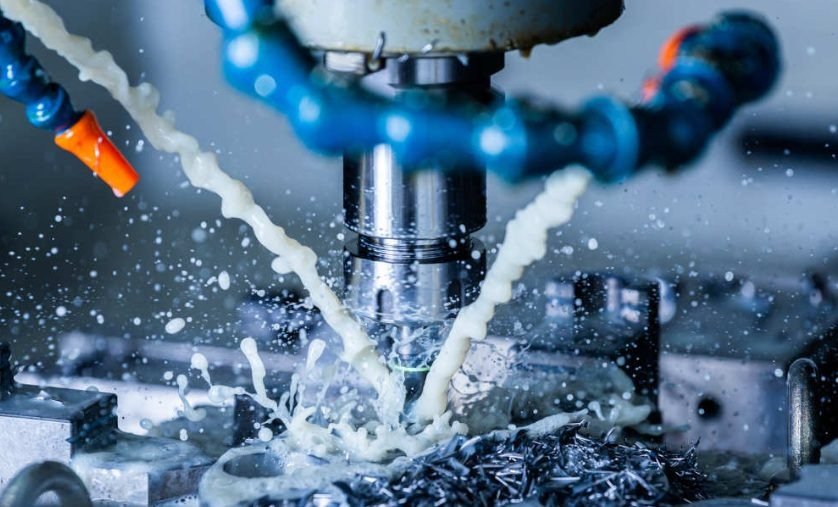
CNC stands for Computer Numerical Control. CNC machining uses pre-programmed software to control the movement of cutting tools with extreme precision.
The machine interprets digital codes to control tool paths, feed rates, spindle speeds, and other critical parameters with extreme precision. This automation minimises human intervention during the actual machining process, leading to consistent results.
Modern CNC machines operate across multiple axes simultaneously. A 3-axis Vertical Machining Centre handles the vast majority of milling operations. More advanced 4-axis and 5-axis machines cut complex geometries in a single setup without repositioning the workpiece.
What CNC Machining Covers
CNC machining is a broader category than milling alone. CNC machining can perform various processes, not just milling. This makes it more versatile, able to handle a broader range of manufacturing needs, from turning and grinding to drilling and cutting.
Ashland Engineering operates a dedicated CNC machine shop with both a CNC lathe and a 3-axis Vertical Machining Centre. Both machines use high-end cutting tool technology to deliver precision and repeatability across every job, from one-off prototypes to batch production runs.
CNC Machining vs Traditional Milling: A Direct Comparison
Understanding each process is useful. However, comparing them directly makes the decision significantly clearer.
Precision and Tolerances
This is where CNC machining holds a decisive advantage.
CNC machines produce parts with great precision and repeatability because they use software programmes that calculate exactly how much material needs to be removed at any given time, during each cutting operation, based on information provided by an engineering drawing or CAD file.
Traditional milling, by contrast, introduces human variability at every pass. Even a highly skilled operator experiences fatigue, makes minor adjustments, and produces parts that vary slightly from one to the next. Human fatigue and varying skill levels can lead to inconsistencies and higher scrap rates in these scenarios.
For components requiring tight tolerances, CNC machining is the clear choice.
Repeatability Across Production Runs
If you need more than one identical component, CNC machining wins outright.
With pre-programmed instructions, CNC machines can replicate the same parts repeatedly. Once a programme is written and proven, the machine produces the same result on the tenth part as it does on the first.
Traditional milling cannot match this. Repeatability depends on the operator reproducing the exact same manual inputs across every part. As volume increases, variation accumulates.
For OEMs, sub-contract manufacturing customers, and anyone ordering repeat batches, CNC repeatability is not a luxury. It is a necessity.
Speed and Efficiency
CNC machining is faster on anything beyond the simplest single-operation jobs.
CNC machines are equipped to perform multiple operations in one setup, reducing the need for manual intervention or moving the workpiece between machines. This automation not only increases efficiency but also minimises the potential for human error.
Furthermore, CNC machines can run unattended once set up. Because the CNC process requires little operator involvement, a single operator can supervise multiple machines at the same time, lowering labour costs.
Traditional milling requires a dedicated operator for each machine throughout the entire cutting cycle.
Complexity of Geometry
Traditional milling handles basic shapes well. However, it struggles with complex profiles, curved surfaces, and multi-feature parts.
CNC milling is particularly versatile, capable of producing complex 3D shapes. Multi-axis CNC machines offer enhanced capabilities, allowing for machining on multiple sides of a part without re-fixturing. This significantly increases efficiency and design freedom for custom CNC machining.
If your component has pockets, contoured surfaces, intersecting features, or critical hole patterns, CNC machining handles it accurately and efficiently. Traditional milling approaches these geometries with difficulty and less reliable results.
Cost Considerations
Cost is often the first question buyers ask. The honest answer is that it depends on the job.
CNC machining can be expensive for small jobs but is generally more efficient and cost effective for jobs requiring a number of the exact same part.
Traditional milling may appear cheaper on a single very simple part with a quick manual setup. However, this cost advantage disappears rapidly as complexity increases, volume grows, or tight tolerances are required.
Precision machining prioritises stability and repeatability, leading to higher time and labour costs on some operations. However, cutting speeds are managed carefully to avoid thermal deformation and ensure dimensional accuracy.
When you factor in scrap rates, rework, and the cost of parts that do not fit their assembly, CNC machining typically delivers lower total cost even when the quoted unit price looks higher.
Which Process Does Your Component Actually Need?
Use this as a practical guide when making your decision.
Choose CNC Machining When:
You need tight tolerances. Any component where fit, function, or safety depends on dimensional accuracy needs CNC. Tolerances of ±0.01 mm and below are routinely achievable on well-maintained CNC equipment.
You need more than one identical part. As soon as repeatability matters, CNC is the right answer. Batch production, OEM supply, and scheduled repeat orders all benefit directly from CNC’s programme-driven consistency.
Your component has complex geometry. Multiple features, contoured surfaces, angular pockets, and multi-face operations all suit CNC machining far better than manual alternatives.
Your parts need quality documentation. ISO 9001 certified machining processes generate traceable, documented quality records. This matters for compliance, warranty, and customer approval requirements. Traditional milling rarely integrates with this level of documentation.
You need a fast, reliable turnaround on repeat orders. Once a CNC programme exists for your part, subsequent batches set up and run quickly. Lead times shorten with each repeat order.
Choose Traditional Milling When:
Your part is very simple with generous tolerances. A flat face, a basic slot, or a straightforward chamfer on a one-off part may not justify CNC setup time.
You need a quick manual modification to an existing component. Removing material, opening a hole slightly, or skimming a surface on a part that is already made can sometimes be quicker on a manual machine.
Volume is extremely low and geometry is basic. A single bracket with two or three features and no critical tolerances may genuinely suit traditional milling when setup cost is the overriding concern.
How Ashland Engineering Approaches This Decision
At Ashland Engineering, the choice between CNC machining and traditional milling is never made arbitrarily. Their engineering team reviews your drawing, understands your tolerance requirements, and recommends the process that delivers the right result at the right cost.
Their dedicated CNC machine shop houses a CNC lathe and a 3-axis Vertical Machining Centre. Both machines run high-end cutting tool technology and operate within Ashland’s ISO 9001 certified quality management system.
This means every component, whether a one-off prototype or a repeat batch, benefits from documented processes, verified tooling, and calibrated digital metrology checks before it leaves the workshop.
Furthermore, Ashland’s in-house CAD/CAM capability means your drawings go directly into the machining process without manual re-entry. Design intent transfers precisely into cutting instructions, eliminating the risk of interpretation errors between your drawing and the finished part.
Ready to Discuss Your Machining Requirements?
Whether your component needs CNC machining, traditional milling, or a combination of both, Ashland Engineering has the expertise and equipment to deliver.
Based in Milton Keynes and serving customers across the UK, get in touch today at sales@ashlandengineering.co.uk or call 01908 382 599 to discuss your component requirements and get a competitive, detailed quote.