Responsible for health and safety at a warehouse or distribution centre? This guide explains UK machine guarding regulations, what compliant guarding looks like in practice, and why bespoke fabricated guarding outperforms catalogue alternatives in busy DC environments.
Distribution centres operate under relentless pressure. High throughput, fast-moving vehicles, automated conveyors, and heavy plant equipment all operate in close proximity to people every single day.
In that environment, machine guarding is not an optional add-on. It is a legal requirement, a moral obligation, and one of the most important engineering controls your facility deploys to protect your workforce.
This guide explains exactly what UK law requires, what compliant machine guarding for distribution centres looks like in practice, and why bespoke fabricated guarding consistently outperforms catalogue alternatives in demanding warehouse environments.
What UK Law Says About Machine Guarding
The starting point for any health and safety manager is understanding the legal framework. In the UK, machine guarding obligations sit primarily within two sets of regulations.
PUWER 1998
The Provision and Use of Work Equipment Regulations 1998, commonly known as PUWER, regulate the standards of safety for equipment used in work environments. Its obligations apply to both employers and employees, as well as those who provide equipment for others to use at work.
The Provision and Use of Work Equipment Regulations 1998 place duties on people and companies who own, operate, or have control over work equipment. Specifically, PUWER requires employers to take effective measures to prevent access to the dangerous parts of machinery. Normally, this means fixed guarding. Where routine access is needed, interlocked guards may be needed to stop movement of dangerous parts before a person can reach the danger zone.
A suitable and sufficient risk assessment must be undertaken to ensure compliance with PUWER and other health and safety regulations and legislation such as the Health and Safety at Work etc Act 1974. The assessment should identify the hazards so measures can be put in place to control the risks and satisfy the relevant statutory requirements.
SMSR 2008
The Supply of Machinery (Safety) Regulations 2008 governs the supply of new machinery. A manufacturer must design and construct a safe machine, evidenced by a UKCA mark. PUWER governs the use of all machinery. The employer must ensure the machine is safe as it is installed, used, and maintained in situ.
In practical terms, this means two things. First, new machinery must arrive with appropriate guards in place. Second, you as the employer carry ongoing responsibility for ensuring guarding remains adequate throughout the machine’s operational life, regardless of what the manufacturer supplied at the point of sale.
Failure to comply with PUWER can result in severe penalties, including fines and legal action. The Health and Safety Executive actively enforces these regulations, making it critical for businesses to ensure compliance.
The PUWER Hierarchy of Guarding Controls
PUWER does not leave the choice of guarding method to chance. It establishes a clear hierarchy that health and safety managers must follow when selecting and implementing machine guarding for distribution centres.
The regulations establish a clear hierarchy of controls and safety measures. Fixed guards are the preferred solution where appropriate, a physical barrier permanently attached and removable only with tools. Where routine access is required, interlocked guards provide the next level of control, stopping dangerous movement before a person can enter the danger zone.
Furthermore, a single non-compliance, for example a guard being too short to comply with standard reach distances, can lead directly to a life-changing injury or even a fatality, with the company facing prosecution.
This is precisely why catalogue guarding solutions frequently fall short in complex distribution centre environments. Standard dimensions, standard heights, and standard configurations rarely match the specific machinery, layout, and workflow of a real DC without modification.
Why Off-the-Shelf Guarding Often Falls Short in Distribution Centres
Walk through any busy distribution centre and you will often find evidence of the problem. Guards that do not quite reach the floor. Panels that leave gaps around non-standard machinery footprints. Adjustable systems repositioned by operators to improve access, undermining the original guarding intent.
Off-the-shelf guarding is not always sufficient. Bespoke or hybrid solutions are often required for complex or imported machinery. Poorly designed guards are frequently bypassed by operators, undermining both compliance and safety.
The root cause is straightforward. Catalogue guarding systems design to standard machine profiles and standard building dimensions. Distribution centres, however, operate bespoke conveyor lines, non-standard automated systems, legacy equipment, and layouts that evolved with the business rather than being designed from scratch.
Consequently, a guard that does not fit properly is not just an aesthetic problem. It is a compliance failure and a safety risk. And a guard that operators routinely remove or reposition is functionally no guard at all.
What Bespoke Machine Guarding Delivers Instead
Bespoke fabricated machine guarding solves these problems at their root. Rather than adapting your operation to fit a catalogue product, bespoke guarding designs and fabricates the solution around your specific machinery, workflow, and environment.
Bespoke machine guarding design considers the machine, the operator, the workflow, and the environment, not just the hazard in isolation. Guarding must be compliant with PUWER and, where relevant, integrated into the machine’s CE and UKCA conformity documentation.
The practical advantages of bespoke fabricated machine guarding for distribution centres are significant.
Precise fit to your specific machinery. Bespoke guarding covers every dangerous part to the correct height and clearance distance, eliminating the gaps that adjustable systems leave around non-standard profiles.
Designed around your operational workflow. Access gates, hinged panels, and maintenance apertures go exactly where your operators need them, reducing the temptation to bypass or remove guarding to perform routine tasks.
Structural integrity for a busy DC environment. A distribution centre that operates forklifts, powered pallet trucks, and high-volume pedestrian traffic needs guarding that withstands accidental impact without deforming or failing. Bespoke steel fabricated guarding provides this structural robustness far more reliably than lighter modular systems.
Longer operational lifespan. Machine guards contribute to the longevity of your industrial equipment by protecting them from potential damage. This protective measure reduces repair or replacement frequency, leading to cost savings and ensuring the continuous operation of machinery.
Types of Bespoke Machine Guarding for Distribution Centres
The range of bespoke guarding solutions relevant to distribution centre environments is broad. Understanding what each type addresses helps health and safety managers plan a comprehensive guarding strategy.
Fixed Steel Machine Guards
Fixed guards provide permanent physical barriers around dangerous machinery components. They require tools to remove, which means they cannot be repositioned casually during routine operations.
Fabricated in mild steel or stainless steel and finished with powder coating, fixed guards suit conveyor drive units, automated sortation systems, robotic pick stations, and any machinery where access during operation is never required.
Perimeter Guarding and Segregation Barriers
Distribution centres increasingly use automated guided vehicles, robotic systems, and autonomous mobile robots alongside human workers. Perimeter guarding creates defined safe zones that separate human traffic from automated equipment at all times.
Bespoke fabricated perimeter guarding fits your exact floor plan, accommodates fire exits and pedestrian crossings with appropriate interlocked access gates, and integrates with your automated system’s safety architecture.
Machine Guarding with Interlocked Access Gates
Where operators need regular access to guarded areas for loading, cleaning, or maintenance, interlocked access gates provide compliant entry without requiring a full machinery shutdown. The gate interlock stops dangerous movement before the operator can enter the danger zone.
Bespoke fabricated interlocked gates design to the exact aperture dimension required, incorporate the appropriate interlock device for the machinery’s risk level, and withstand the daily use of a busy DC environment without degrading.
Bollards, Posts, and Impact Barriers
Beyond machinery guarding, distribution centres need structural protection for racking systems, building columns, pedestrian routes, and charging stations. Bespoke fabricated steel bollards and impact barriers absorb and redirect vehicle impact, protecting both infrastructure and people.
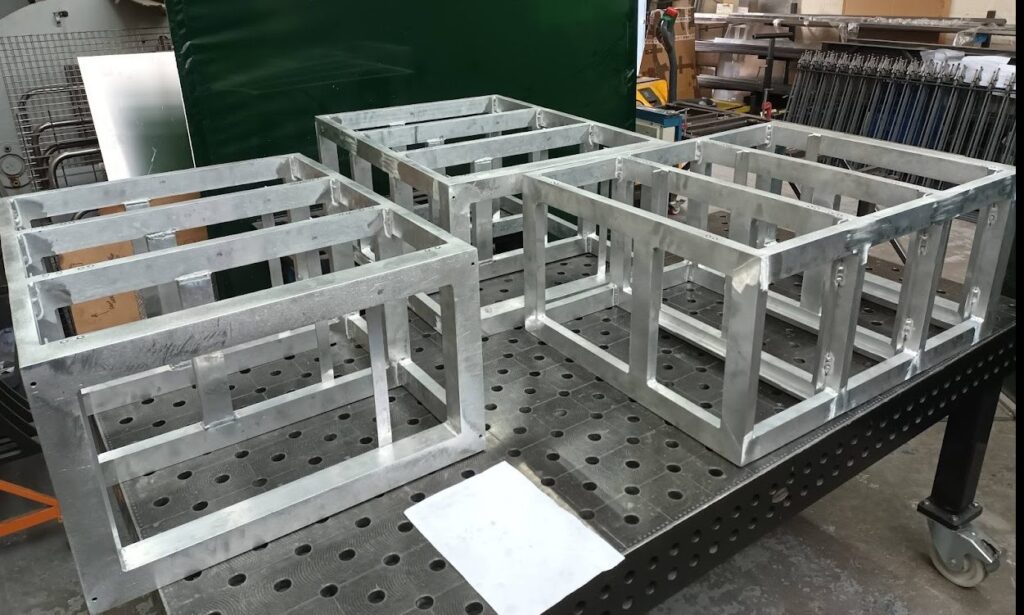
Ashland Engineering fabricates industrial fabrications for factories, warehouses, and distribution centres including barriers, benches and workstations, bespoke machine guarding, trollies, racking, cabinets, bollards, posts, stillages, and material storage racks.
The Bespoke Guarding Process: From Risk Assessment to Installation
A properly executed bespoke machine guarding project follows a structured process. Health and safety managers commissioning new guarding should expect the following stages from a competent fabricator.
Site survey and risk assessment review. The fabricator reviews your existing risk assessment and conducts a physical survey of the machinery, the surrounding environment, and the operational workflow. This produces a complete picture of what guarding must achieve.
CAD design and drawing approval. A competent process produces drawings for approval before any fabrication begins, ensuring the customer has full visibility of dimensions, materials, and access provisions before steel is cut. This stage is where compliance with PUWER reach distances, heights, and gap dimensions is verified against the relevant British Standards.
Fabrication to ISO 9001 certified quality standards. The guarding fabricates in structural steel using MIG welding for rigid, permanent joints. Powder coating provides corrosion resistance and colour-codes guard types for clear visual identification in the DC environment.
Delivery and installation coordination. Bespoke guarding installs to the specific anchor points, floor conditions, and access constraints of your facility. Good fabricators coordinate delivery and installation to minimise operational disruption.
Ashland Engineering follows this process for every machine guarding project. Their in-house CAD/CAM engineering design capability means drawings go directly from the design stage into fabrication without re-entry errors. Their ISO 9001 certified quality management system ensures every guarding component meets the agreed specification before it leaves the workshop.
Why Choose Ashland Engineering for Machine Guarding in Your Distribution Centre
Ashland Engineering designs and manufactures bespoke, heavy-duty warehouse infrastructure tailored to your exact operational requirements, built strictly to ISO 9001 standards using appropriate structural grades for long-term industrial use.
Based in Milton Keynes with direct M1 access, Ashland Engineering serves distribution centres and warehouses across London, the South East, and the wider UK. Their full in-house capability covers design, laser cutting, CNC press brake forming, MIG welding, and powder coating, all under one ISO 9001 certified quality system.
Furthermore, their experienced team works directly from your risk assessment, site survey, and drawings. They also work from sketch-level briefs for facilities where engineering drawings do not exist for legacy machinery installations.
Ready to Commission Bespoke Machine Guarding for Your Distribution Centre?
Whether you need fixed machine guards, perimeter segregation barriers, interlocked access gates, or structural impact protection for your warehouse or DC, Ashland Engineering delivers compliant, durable, bespoke fabricated solutions.
Get in touch today at sales@ashlandengineering.co.uk or call 01908 382 599 to discuss your machine guarding requirements and receive a competitive, detailed quote.