Unsure which metal to use for your custom metal fabrication project? This plain-language guide covers mild steel, stainless steel, aluminium, and copper, including properties, applications, finishes, and cost, so you can specify with confidence.
Choosing the right material is one of the first decisions you make on any custom metal fabrication project. Get it right and you get a part that performs, lasts, and finishes well. Get it wrong and you pay more than you need to, or end up with something that corrodes, deforms, or simply does not suit its application.
The good news is that this decision is not complicated once you understand what each material actually does. This guide walks through the four main materials used in custom metal fabrication at Ashland Engineering: mild steel, stainless steel, aluminium, and copper. For each one, you will find the properties that matter, the applications it suits, the finish options available, and a realistic sense of what it costs relative to the alternatives.
Mild Steel
Mild steel is the most widely used material in custom metal fabrication, and for good reason. It is affordable, easy to cut and weld, takes finishing well, and offers more than adequate strength for the vast majority of structural and industrial applications.
Properties
Mild steel refers to carbon steel with a low carbon content, typically between 0.05 and 0.25 percent. That carbon range keeps the material ductile enough to form and weld without cracking, while still delivering the tensile strength that structural applications need.
It is heavy compared to aluminium. It is not inherently corrosion-resistant. Left untreated, it rusts when exposed to moisture. However, these are solvable problems, and the solutions are well-established and cost-effective.
Applications
Mild steel suits structural and general-purpose fabrication across almost every industry. Machine guarding, warehouse racking, stillages, lifting frames, industrial workbenches, material handling equipment, gates, railings, staircases, and architectural metalwork all commonly use mild steel as their primary material.
Mild steel is affordable and easy to form, making it suitable for structural and general-purpose applications. For custom metal fabrication projects where function and economy matter more than corrosion resistance or low weight, it is usually the right starting point.
Finish Options
Because mild steel rusts without protection, surface finishing is mandatory rather than optional. The main options are powder coating, hot-dip galvanising, and paint.
Powder coating bonds a dry polymer film to the metal surface through heat curing. It comes in any RAL or BS colour, resists chipping and abrasion well, and suits both indoor and outdoor applications. Hot-dip galvanising coats the steel inside and out with zinc, giving a layer of protection that remains effective even if the surface is scratched. For outdoor structural applications in exposed environments, galvanising beneath a powder coat top layer gives the most durable result.
Cost Profile
Fabrication for simple steel brackets typically starts at £30 to £80 per unit for batch runs of 10 to 50, with one-off pieces often hitting £80 to £200 because setup and labour dominate costs. Mild steel material cost is the lowest of the four materials covered here. It is the benchmark against which the others are measured.
Stainless Steel
Stainless steel is the right choice when corrosion resistance, hygiene, or finish quality take priority over raw material cost. It costs more than mild steel. However, in the right application, that cost is justified by longer service life, lower maintenance, and properties that mild steel simply cannot match.
Properties
Stainless steel gets its corrosion resistance from chromium. A minimum of 10.5 percent chromium in the alloy forms a passive oxide layer on the surface that repairs itself when damaged. This makes it genuinely corrosion-resistant rather than just coated against corrosion.
With its chromium content, stainless steel resists rust and corrosion, making it ideal for environments with high moisture or chemical exposure. Its ability to maintain structural integrity in harsh conditions adds to its appeal in sterile and clean settings.
The two grades most commonly used in custom metal fabrication are 304 and 316. Grade 304 suits most general applications. Grade 316 adds molybdenum to the alloy, which gives it significantly better resistance to chloride-induced corrosion. In marine environments, food processing, chemical handling, and coastal applications, 316 is the correct choice.
Applications
Commercial kitchens, food processing equipment, catering furniture, pharmaceutical environments, washdown areas, hygienic enclosures, and any application where cleaning chemicals or moisture are present day-to-day all suit stainless steel.
Common uses include kitchen appliances, medical instruments, and the food and beverage industry. Its hygienic properties make it a top choice for environments that demand cleanliness and longevity.
TIG welding is the preferred process for stainless steel in custom metal fabrication. It produces narrow, clean weld beads with minimal heat discolouration and a smooth, crevice-free surface that is straightforward to clean and inspect.
Finish Options
Stainless steel does not require a protective surface finish in the way mild steel does. The most common finish options are a brushed finish produced by mechanical polishing, a mill finish left from the rolling process, or a mirror polish for decorative architectural applications.
Powder coating is available on stainless steel but is less common. Where it is used, it adds colour without compromising the underlying corrosion resistance of the base material.
Cost Profile
Stainless steel and aluminium cost more: expect 20 to 60 percent higher material and processing charges, so a stainless part that costs £300 in mild steel could be £360 to £480. Processing costs are higher because stainless steel is harder to cut and weld, cutting speeds are slower, and tooling wears faster. The material’s high strength supports long-lasting applications, resisting wear and deformation over time. Its durability offsets the moderate initial cost by reducing replacement and maintenance expenses.
Aluminium
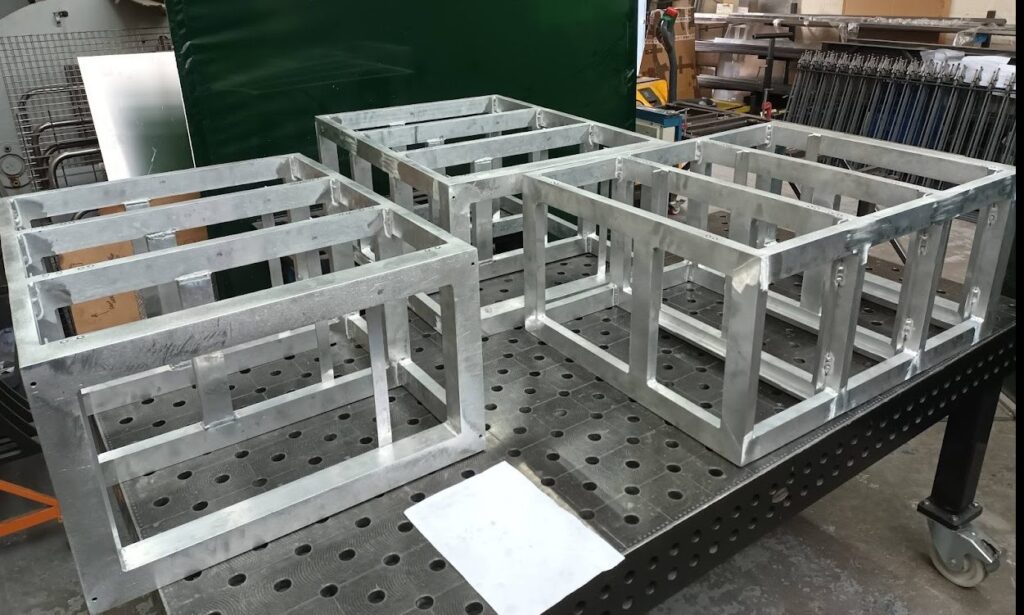
Aluminium is the material to reach for when weight matters. It is roughly one third the density of steel, which makes it the standard choice in any application where reducing mass directly improves performance, handling, or economy.
Properties
Aluminium is lightweight, naturally corrosion-resistant, and easy to machine. Aluminium is known for its lightweight nature, which makes it particularly suited for industries where reducing weight is paramount.
It does not corrode in the way steel does. Instead, it forms a thin aluminium oxide layer on its surface that acts as a natural barrier against further oxidation. This makes it suitable for outdoor applications without additional surface treatment in many cases, though anodising or powder coating improves both appearance and durability.
Aluminium conducts heat and electricity well. It is also readily recyclable, which matters to customers with sustainability requirements in their supply chain.
Welding aluminium requires more skill than welding steel. TIG welding with alternating current is the standard process. The welder must manage the material’s high thermal conductivity and tendency to absorb hydrogen from the atmosphere, both of which cause porosity if technique is poor.
Applications
Aluminium is extensively used in aerospace and automotive applications, as it can significantly improve fuel efficiency by cutting down on mass. In custom metal fabrication for general industry, it suits transport vehicles and trailers where payload capacity matters, lightweight enclosures, access panels, covers, and guards, architectural metalwork where a clean anodised finish is preferred, and portable or hand-operated equipment where operator effort is a consideration. Komacut
Finish Options
Anodising is the finish most closely associated with aluminium. It is an electrochemical process that thickens the natural oxide layer, producing a hard, corrosion-resistant surface that takes colour well and has a clean, modern appearance. Powder coating is also available on aluminium and suits applications where colour matching to other elements is required.
Because aluminium is naturally corrosion-resistant, bare or mill-finish aluminium is also a legitimate option in many applications, particularly for internal or structural elements where appearance is secondary.
Cost Profile
Aluminium material costs more per kilogram than mild steel. However, because it is so much lighter, the weight of finished parts is lower, which reduces both material cost per part and shipping cost on volume orders. Setup costs are generally comparable to mild steel. The specialist welding skill required for aluminium TIG work adds to fabrication labour cost relative to a simple mild steel MIG-welded part.
Copper
Copper is a specialist material in custom metal fabrication. Most buyers will not need it. However, for specific applications, particularly those involving electrical conductivity and heat transfer, it is the only material that does the job properly.
Properties
Copper is the best electrical conductor of any commercially practical metal. It also conducts heat extremely well, which makes it the go-to material for heat exchangers, bus bars, electrical contacts, and thermal management components.
It is soft and ductile, which makes it easy to machine and form. However, it does not have the structural strength of steel or aluminium, so it is rarely used for load-bearing structural applications. Copper is also significantly more expensive than steel or aluminium, which makes it a deliberate choice for specific functional reasons rather than a general-purpose material.
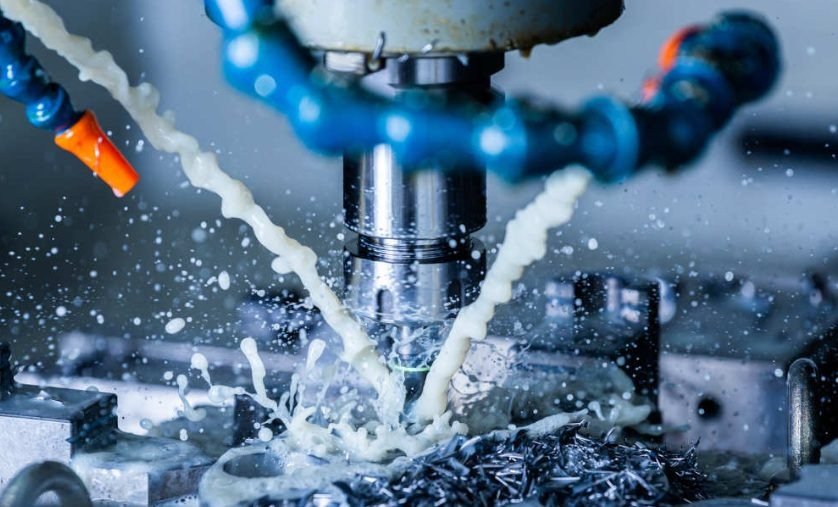
Ashland Engineering’s CNC machining department routinely processes high-conductivity copper alongside standard carbon steels and specific alloy grades, with strict material traceability throughout.
Applications
Electrical busbars and connectors, heat exchanger components, induction heating tooling, precision electrical contacts, and thermal management parts in power electronics and industrial equipment are the primary uses for machined copper components in custom metal fabrication.
It also appears in architectural metalwork, where its distinctive warm colour and natural patination over time give a visual character that no other metal replicates. Roofing, cladding, decorative panels, and feature metalwork in high-specification buildings all use copper for this reason.
Finish Options
Copper develops a natural patina over time as its surface oxidises, shifting from the characteristic warm orange-brown through to the green verdigris seen on historic buildings. This patination can be controlled and accelerated chemically to achieve a desired aesthetic.
For functional machined copper components in electrical or thermal applications, bare machined surfaces are usually the correct finish. Lacquering is available where oxidation of functional surfaces must be prevented.
Cost Profile
Copper is considerably more expensive than steel or aluminium by weight. Material cost alone can be four to six times that of mild steel depending on current commodity prices, which fluctuate significantly. As a result, copper is only specified where its functional properties make it genuinely necessary. When it is the right material, there is no cost-effective substitute.
How to Choose the Right Material for Your Custom Metal Fabrication Project
The decision comes down to four practical questions. What environment will the part operate in? What loads will it carry? How much does it weigh? And what finish do you need?
If the part is structural and will be painted or powder coated, mild steel is almost always the right answer. It is the most cost-effective option for the majority of custom metal fabrication work.
If the part will be exposed to moisture, cleaning chemicals, or food contact without a protective coating, stainless steel is the correct choice. The additional cost is offset by longer service life and the absence of ongoing maintenance.
If weight reduction directly improves the performance or usability of the part, aluminium is worth considering. It costs more to fabricate than mild steel but delivers a finished part that is substantially lighter.
If the part needs to conduct electricity or transfer heat, copper is the material to specify. The cost is high, but no other commercially practical metal does this job as well.
Talk to Ashland Engineering About Your Material Choice
If you are unsure which material suits your project, the most useful thing you can do is describe what the part needs to do and let an experienced fabricator advise you. Ashland Engineering works with mild steel, stainless steel, aluminium, and copper across their fabrication and CNC machining services, and their team will help you make the right call before any material is ordered or cut.
Get in touch at sales@ashlandengineering.co.uk or call 01908 382 599 to discuss your custom metal fabrication project.