Thinking about bespoke gates, railings, or handrails for your Buckinghamshire property? This buyer’s guide covers materials, finishes, the design process, and what to expect from a professional local fabricator.
There is a particular kind of frustration that comes with trying to fit a standard gate to a non-standard entrance. The posts land in the wrong place. The height is close but not right. The style clashes with the house. You spend money and end up with something that almost works.
Bespoke gates sidestep all of that. They are made for your entrance, your measurements, and your property. The same goes for bespoke railings and handrails. When something is built from scratch to your specification, it fits properly, looks right, and lasts considerably longer than catalogue alternatives.
This guide is for homeowners across Buckinghamshire thinking about commissioning bespoke metalwork, whether that is driveway gates in Gerrards Cross, front garden railings in Marlow, or internal handrails in a period property in Aylesbury. Here is everything you need to know before you pick up the phone.
Why Bespoke Rather Than Off-the-Shelf?
The honest answer is that catalogue gates and railings are designed for the average property. Buckinghamshire properties are frequently anything but average.
Period homes have awkward entrance widths and sloped driveways. Modern houses have specific design languages that clash with generic tubular steel. Rural properties need agricultural-grade strength that standard residential products do not provide.
Bespoke fabrication removes these constraints entirely. The fabricator starts with your measurements and your brief, not with a stock size that needs adapting. Consequently, the finished product fits the space, suits the architecture, and holds up to whatever the British weather and daily use throw at it.
Choosing the Right Material
Material choice shapes the look, the maintenance requirements, and the cost of your gate or railing project. There are three main options.
Mild Steel
Mild steel is the most widely used material for bespoke gates and railings. It is strong, welds cleanly, and takes a powder coat or galvanised finish well. It suits everything from traditional estate-style entrances to clean-line contemporary designs.
The one consideration with mild steel is that it must be finished to prevent rust. Left bare or poorly finished, it corrodes. Finished correctly, it lasts for decades with minimal upkeep.
Aluminium
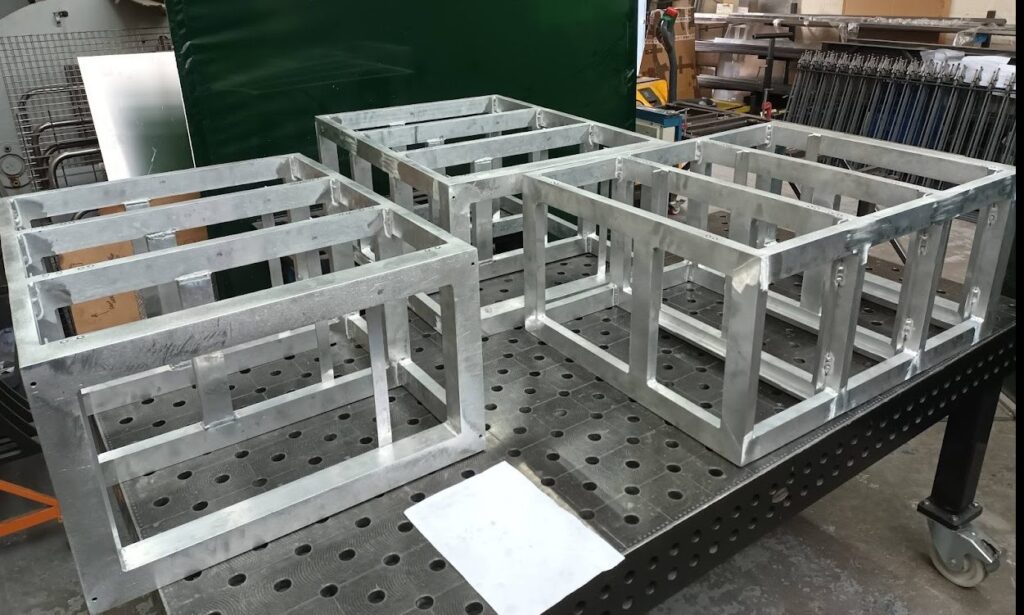
Aluminium is lighter than steel and naturally corrosion-resistant, which makes it attractive for homeowners who want low maintenance above all else. It also anodises well, giving a clean, modern finish in a range of colours.
The trade-off is strength. For driveway gates that will take daily use and occasional contact from vehicles, mild steel with a quality galvanised finish is still the more durable choice. Aluminium suits pedestrian gates, garden railings, and decorative applications where weight and corrosion resistance matter more than heavy-duty structural strength.
Stainless Steel
Stainless steel is the premium option. It resists corrosion without any surface treatment and offers a distinctive brushed or polished appearance that suits contemporary architecture particularly well. It costs more than mild steel and is more demanding to weld to a high standard, which is why TIG welding is the preferred process for stainless work.
For internal handrails in a high-specification home, stainless steel is often the right answer. For external gates and railings, mild steel with a quality finish delivers comparable longevity at lower cost.
Understanding Your Finish Options
The finish on your metalwork determines how it looks on day one and how it holds up over the years that follow. Get this right and you will not need to touch it for a very long time.
Powder Coating
Powder coating uses electrostatically charged dry powder blown onto the metal surface. The coated metalwork then passes through an oven, where the powder melts and bonds to the surface, creating a smooth, hard-wearing finish.
Powder coating is available in any RAL or BS colour, which means your gates can match your front door, your window frames, or any other element of your property’s exterior. It is the most popular finish for residential bespoke gates and railings in Buckinghamshire because it combines durability with design flexibility.
Hot-Dip Galvanising
Hot-dip galvanising coats the steel inside and out with zinc, and an optional powder coat top layer in any RAL colour adds the look you want over the top. Galvanised and coated steel, hung on properly set posts, should not need attention for decades.
For gates and railings exposed to heavy weather, galvanising beneath the powder coat is worth the additional investment. The zinc layer provides a secondary barrier against corrosion even if the powder coat suffers scratches or minor damage over time.
Paint
Paint is a lower-cost alternative to powder coating and suits properties where a traditional hand-painted finish aligns with the aesthetic. The downside is durability. Paint chips and scratches more readily than powder coat, and any bare steel exposed to weather will start to rust unless touched up promptly.
For most Buckinghamshire homeowners, powder coating over galvanised mild steel is the combination that delivers the best long-term value.
The Design Process: From Brief to Finished Gate
Many people assume that commissioning bespoke metalwork is complicated. In practice, a good fabricator makes it straightforward. Here is how the process typically runs.
Initial enquiry and measurements. You contact the fabricator with the basics: the location, the approximate dimensions, and a description of what you have in mind. Photos of the entrance or staircase help considerably. At this stage, you do not need finished drawings.
Site visit or measurement check. For gates and railings, accurate measurements are non-negotiable. A sloped driveway, an uneven threshold, or an awkward post position all affect the design. A fabricator who visits the site before quoting is preferable to one who works from measurements alone.
Design development and drawing. The fabricator produces a drawing or 3D model showing the proposed gate or railing design, with dimensions confirmed. Ashland Engineering uses 3D parametric CAD tools, which means you can see exactly what will be made before any steel is cut.
Quote and approval. You review the drawing and the quote and confirm any changes before fabrication starts. A reputable fabricator will not proceed until you are satisfied with both.
Fabrication. The gate or railing is made in the workshop, welded, ground smooth, and prepared for finishing. Powder coating or galvanising follows.
Installation. Posts go into the ground or fix to masonry, the gate hangs on its hardware, and any final adjustments happen on site.
Ashland Engineering handles every stage of this process. Their in-house CAD/CAM design capability, fabrication shop, and full range of finishing options mean your project does not pass through multiple suppliers. Everything happens under one ISO 9001 certified quality system, from the first drawing to the finished installation.
What to Ask Before Committing
A few questions upfront save headaches later.
Do they work from sketches? Not every customer arrives with engineering drawings. A fabricator who can take a rough sketch or a reference photo and develop it properly is far more useful than one who needs a finished technical brief before they can begin.
What finishes do they offer in-house? Powder coating done externally by a third party adds lead time and introduces a gap in quality responsibility. A fabricator with in-house finishing is simpler to work with and easier to hold accountable.
Are they ISO 9001 certified? For a residential customer, this matters more than it might seem. It means the fabricator operates a documented quality system, not just a well-meaning workshop where results depend on who happens to be working that day.
Can they provide a drawing for approval before fabrication starts? This protects you. Once steel is cut and welded, changes become expensive. A drawing approval stage costs the fabricator nothing and gives you the chance to refine the design before it is fixed in metal.
Serving Buckinghamshire Homeowners
Ashland Engineering is based in Milton Keynes and works with residential customers across Buckinghamshire, including Aylesbury, Buckingham, High Wycombe, Beaconsfield, Marlow, Amersham, Gerrards Cross, and the surrounding villages. They fabricate bespoke gates, railings, handrails, balustrades, and staircases in mild steel, stainless steel, and aluminium, finished to the customer’s specification.
The starting point is a conversation. Whether you have a clear vision or just a vague sense that catalogue options are not going to work, they will help you get to the right answer.
Get in Touch
Contact Ashland Engineering at sales@ashlandengineering.co.uk or call 01908 382 599 to discuss your bespoke gates, railings, or handrails project. Send over a photo, a sketch, or just a description of what you need, and they will take it from there.