Forklift collisions with warehouse racking cause thousands of pounds in damage every year across UK distribution centres. Here is how to protect your racking, your stock, and your team with the right steel safety products.
Warehouse racking is expensive. A standard adjustable pallet racking bay costs hundreds of pounds. A full warehouse installation runs into tens of thousands. Yet every day, across distribution centres and fulfilment warehouses throughout the UK, forklifts clip uprights, nudge end frames, and roll into rack legs with enough force to cause serious structural damage.
The consequences range from bent uprights and displaced beams to full rack collapse. Rack collapse puts stock, equipment, and people at risk. It also triggers expensive downtime, insurance claims, and potentially a Health and Safety Executive investigation.
The good news is that most forklift damage to warehouse racking is preventable. The right physical protection, properly specified and correctly installed, absorbs impacts before they reach the rack itself.
Why Warehouse Racking Is So Vulnerable
Racking uprights are designed to carry vertical loads. They are not designed to absorb lateral impact. Even a relatively slow-moving forklift carrying a loaded pallet delivers a significant lateral force on contact. That force goes directly into the upright, bending or buckling it at the base.
The base of the upright is the most vulnerable point. It sits close to floor level, in exactly the zone where forklift trucks, pallet trucks, and reach trucks operate. Drivers manoeuvring in tight aisles, reversing under time pressure, or misjudging clearance on a loaded run hit this zone repeatedly over the working life of the installation.
Damaged uprights do not always fail immediately. They often continue to carry load in a compromised state, which makes them more dangerous, not less. A rack that looks functional after a minor impact may have reduced load capacity and a higher risk of failure under subsequent loading.
The HSE Position on Racking Safety
The Health and Safety Executive publishes clear guidance on racking safety in the workplace. Under the Provision and Use of Work Equipment Regulations (PUWER) and the Health and Safety at Work Act, employers have a duty to maintain equipment in a safe condition. Damaged racking that continues in service breaches that duty.
SEMA, the Storage Equipment Manufacturers Association, publishes the Code of Practice for the design and installation of static steel shelving and racking. Under SEMA guidance and EN 15635:2008, employers should carry out regular racking inspections and act on damage findings promptly.
In practice, the most cost-effective approach is not to inspect and repair damage after it occurs. It is to prevent it in the first place.
The Main Types of Warehouse Racking Protection
Upright Protectors and Column Guards
Upright protectors, also called column guards or post protectors, fit around the base of individual racking uprights. They are typically made from heavy gauge steel and designed to take the impact of a passing forklift rather than the upright itself.
A good steel upright protector absorbs the impact and deflects the load away from the rack leg. It bolts to the floor independently of the racking, so the racking itself does not take the force.
Steel upright protectors outlast plastic alternatives significantly. In busy warehouse environments, plastic guards deform and crack after repeated low-speed impacts. Steel takes the same impacts repeatedly without losing structural integrity. When a steel guard shows visible damage, it has done its job and can be replaced. The rack behind it is undamaged.
End Frame Protectors
The end of each racking run is the highest-risk point in the warehouse. Forklifts approach and depart from aisle ends repeatedly throughout the working day. End frame protectors wrap around the full end frame of the racking bay, providing protection to both uprights and the bottom beam in a single fabricated assembly.
Bespoke end frame protectors, made to match the exact dimensions of the racking installation, offer better coverage than off-the-shelf alternatives. A fabricator can produce protectors to suit any upright size, any frame width, and any floor fixing arrangement.
Rack End Barriers and Safety Barriers
Rack end barriers are freestanding or floor-fixed steel barriers positioned at the end of racking runs. They create a physical separation between forklift traffic and the rack structure.
For busy warehouses with high forklift traffic, rack end barriers are one of the most effective protective measures available. They stop forklift trucks from reaching the racking itself, absorbing any impact before it gets close to the structure.
Steel safety barriers in warehouse environments are typically made from 100mm to 150mm diameter steel tube or from fabricated rectangular hollow section. They are hot-dip galvanised or powder coated for durability and bolted to the floor through base plates.
Pedestrian Barriers and Zone Separation
Separating forklift and pedestrian zones is both a safety requirement and an effective way to reduce racking damage caused by distracted or hurried driving.
Clearly defined pedestrian routes, marked by continuous steel barriers, reduce the number of unplanned manoeuvres that happen when pedestrians and forklifts share the same space. Fewer unexpected movements mean fewer incidents and less racking damage.
Steel pedestrian barriers in a warehouse or distribution centre context are typically low-level, around 500mm to 1000mm high, and positioned to guide pedestrian flow without restricting forklift access to racking aisles.
Floor-Fixed Bollards and Post Protectors
Individual steel bollards offer point protection for columns, doorways, loading bay edges, control panels, and other fixed assets. In a warehouse setting, they are frequently used to protect structural columns that fall within or close to forklift traffic routes.
Bollards should be fixed to the floor through substantial base plates with correctly specified anchor bolts. A bollard that pulls free under impact provides no protection. A correctly installed steel bollard redirects forklift impact into the floor slab rather than into whatever it is protecting.
Specifying the Right Protection for Your Warehouse
The right specification depends on the layout of your warehouse, the type of forklift equipment in use, the aisle widths, and the volume of traffic. A site survey by an experienced fabricator can identify the highest-risk areas and recommend the most cost-effective protection solution.
Key questions to consider when specifying racking protection include the weight of forklifts operating in the building, the speed at which they typically travel in aisles, the frequency of use in each aisle, and the value of the stock held on the racking.
Higher traffic, heavier equipment, and higher-value stock all justify a more robust protection specification.
Bespoke Steel Fabrication for Warehouse Protection
Standard off-the-shelf racking protection products work in some situations. In many others, the racking layout, column positions, or aisle configurations do not match standard product dimensions. That is where bespoke steel fabrication adds real value.
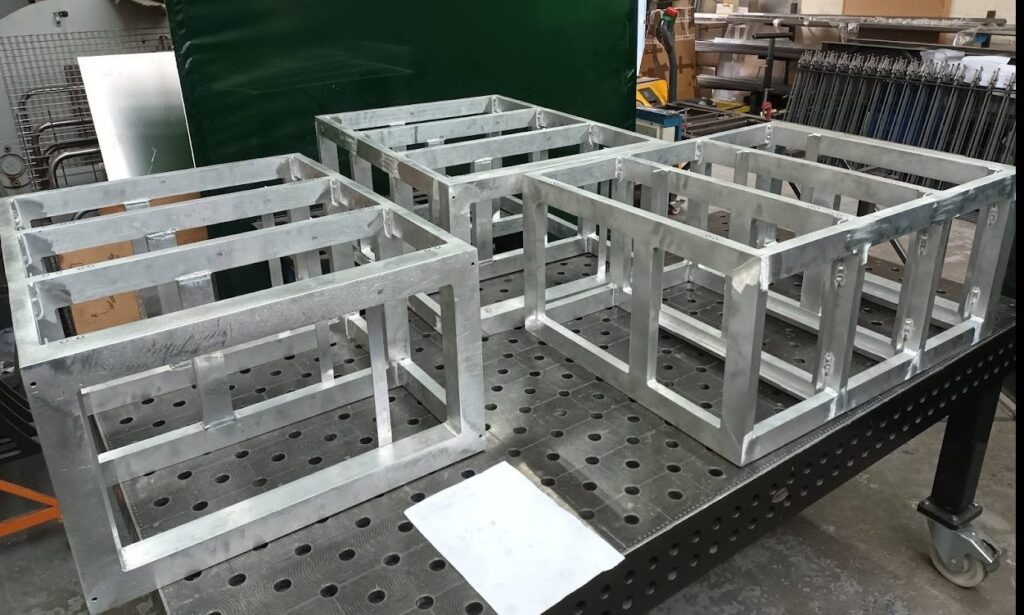
At Ashland Engineering in Milton Keynes, the team fabricates bespoke warehouse racking protection products for distribution centres and fulfilment warehouses across Buckinghamshire, Northamptonshire, Bedfordshire, and the wider UK. Upright protectors, end frame guards, safety barriers, bollards, and pedestrian separation systems are all produced to customer dimensions in mild steel, finished to specification.
ISO 9001 certification means every fabricated component meets a documented quality standard. Supply can be arranged as a one-off installation package or as ongoing batch production for phased fit-outs or replacement stock.
To discuss your warehouse racking protection requirements, contact the team at sales@ashlandengineering.co.uk or call 01908 382 599.