Not sure whether MIG welding or TIG welding is right for your project? This plain-language guide covers materials, speed, finish quality, and cost, so you can choose the right welding process with confidence.
If you have ever searched for welding services in the UK, you have almost certainly seen both MIG welding and TIG welding mentioned. Most suppliers offer both. However, very few explain which one you actually need and why.
This guide fixes that. By the end, you will know exactly which welding process suits your project, your material, and your budget.
What Is MIG Welding?
MIG stands for Metal Inert Gas. It is also known as Gas Metal Arc Welding, or GMAW.
MIG welding feeds a continuous wire electrode through a welding gun. The gun simultaneously releases a shielding gas, typically a blend of argon and CO2, to protect the molten weld pool from atmospheric contamination.
As the wire melts, it fills the joint between two metal pieces and fuses them together. The process is fast, continuous, and easy to maintain over long runs.
Key Strengths of MIG Welding
MIG welding excels in several situations. Firstly, it is significantly faster than TIG welding. The continuous wire feed allows welders to cover large areas quickly without stopping to replace electrodes or filler rods.
Secondly, it suits thicker materials well. MIG delivers strong penetration on mild steel sections from 3mm upwards, making it ideal for structural fabrication.
Thirdly, it is cost-effective for production work. Faster deposition rates mean lower labour costs per metre of weld. As a result, MIG welding is the standard choice for batch production, volume runs, and industrial fabrications.
What Is TIG Welding?
TIG stands for Tungsten Inert Gas. It is also known as Gas Tungsten Arc Welding, or GTAW.
TIG welding uses a non-consumable tungsten electrode to create the arc. A separate filler rod is added manually by the welder to build the weld pool. Argon shielding gas protects the joint throughout the process.
Because the welder controls the heat input manually, often using a foot pedal, TIG welding offers exceptional precision. The result is a cleaner, narrower, and more visually refined weld.
Key Strengths of TIG Welding
TIG welding produces superior weld quality. The welds are smooth, consistent, and require minimal post-weld cleanup or grinding.
Furthermore, TIG handles thin materials far better than MIG. On materials under 3mm, MIG’s higher heat input risks burn-through. TIG’s precise heat control eliminates that risk.
TIG also suits a wider range of metals. In addition to mild steel and stainless steel, TIG works excellently on aluminium, copper alloys, titanium, and other non-ferrous materials that demand careful handling.
MIG Welding vs TIG Welding: A Direct Comparison
Understanding each process is useful. However, seeing them side by side makes the decision much easier.
Speed
MIG welding is considerably faster. For high-volume production, structural fabrication, and long continuous welds, MIG is the clear winner. TIG welding is slower because the welder adds filler material manually and maintains tighter control throughout.
Weld Finish and Appearance
TIG welding consistently produces a cleaner, more aesthetically refined finish. The characteristic “stacked coin” appearance of a good TIG weld is difficult to achieve with MIG. Consequently, TIG is the preferred choice wherever the weld is visible or where appearance matters.
MIG welds are structurally sound but may produce more spatter. Therefore, they often need grinding or finishing if the surface will be seen by the end user.
Material Suitability
Both processes work on mild steel, stainless steel, and aluminium. However, TIG performs better on thin gauges and specialist metals. MIG is more efficient on thicker sections where speed matters more than finish quality.
For stainless steel in particular, TIG produces cleaner results with far less oxidation and heat discolouration. This makes TIG the preferred process for hygienic applications, such as commercial kitchen equipment and food-processing components.
Cost
MIG welding is generally more cost-effective. Faster process speeds, lower equipment costs, and lower skill demands all reduce the price per metre of weld.
TIG welding costs more. The process requires highly skilled operators, takes longer, and uses more advanced equipment. Nevertheless, the higher upfront cost often pays off when quality, compliance, or aesthetics are critical. Rework and rejection costs drop significantly when TIG is the right tool for the job.
Skill Level Required
MIG welding is easier to learn and well-suited to consistent, repeatable production work. TIG welding demands a significantly higher skill level. The welder controls heat, filler rod, and torch position simultaneously, which takes years of experience to master.
This is precisely why choosing a fabricator with genuinely skilled TIG welders matters so much when your project demands precision.
Which Projects Need MIG Welding?
MIG welding is the right choice when your project involves the following:
Structural fabrication such as machine guarding, racking, stillages, platforms, and warehouse equipment. These applications demand strength and speed rather than decorative finish.
Batch and volume production where consistent output at controlled cost is the priority. MIG’s speed makes it far more economical across repeat production runs.
Thicker steel sections from 3mm and above, where MIG delivers strong penetration reliably.
Fabrications that will be powder coated or painted, where the final surface finish conceals the weld appearance entirely.
At Ashland Engineering, MIG welding forms a core part of their fabrication capability. They regularly supply MIG-welded assemblies to manufacturers, OEMs, warehouse operators, and commercial clients across the UK.
Which Projects Need TIG Welding?
TIG welding is the right choice when your project involves the following:
Thin materials under 3mm, where MIG risks burning through. TIG’s precise heat control keeps thin sheet intact and dimensionally accurate.
Stainless steel with visible welds, particularly in commercial kitchens, food processing, catering equipment, and architectural metalwork. TIG produces clean, hygienic, aesthetically pleasing joints that require minimal finishing.
Aluminium fabrications for specialist applications, including motorsport components, lightweight enclosures, and transport parts. TIG handles aluminium’s thermal properties more accurately than MIG.
Precision assemblies where tight tolerances are essential. TIG’s narrow, focused arc delivers consistent results on complex geometries and intricate joints.
Ashland Engineering’s team includes highly skilled TIG welders with real-world experience on complex projects. They have fabricated bespoke TIG-welded aluminium assemblies for motorsport powertrain applications, stainless steel commercial kitchen equipment, and precision components for OEM customers across the UK.
Can One Project Use Both?
Absolutely, and many do.
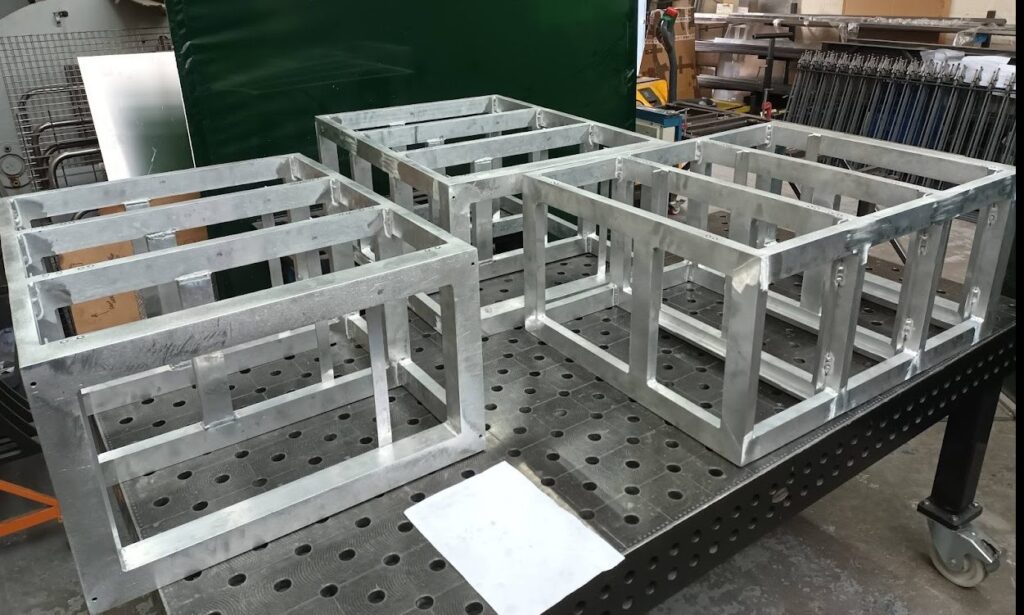
A skilled fabricator will often combine both processes on the same job. For example, they might MIG weld the structural frame for speed and cost efficiency, then TIG weld the visible external faces for a clean finish. This approach delivers the best of both processes without unnecessary cost.
This is exactly the kind of decision an experienced fabricator makes on your behalf when you brief them properly. It is also a strong reason to choose a welding company that offers both MIG and TIG capability in-house.
Choosing the Right Welding Partner in the UK
Whether your project needs MIG welding, TIG welding, or both, the fabricator you choose matters as much as the process itself.
Look for a company with ISO 9001 certification, which guarantees a structured quality management system. Also look for in-house CAD/CAM capability to support design review before production starts. Experience across multiple materials and applications, and a track record with OEMs, tradespeople, and commercial clients, all point to a fabricator who can handle your project properly.
Ashland Engineering ticks every one of these boxes. Based in Milton Keynes, they serve customers across the UK with premium quality MIG and TIG welding services for steel, stainless steel, and aluminium. They handle everything from one-off prototypes to repeat batch production runs, all under an ISO 9001 certified quality system.
Ready to Discuss Your Welding Project?
Get in touch with the team at Ashland Engineering today. Send your drawings, sketch, or project description to sales@ashlandengineering.co.uk or call 01908 382 599. They will advise on the right welding process for your application and provide a competitive, detailed quote.